Article
Talking AI, Accessibility and Creative Futures at Norwich University of the Arts
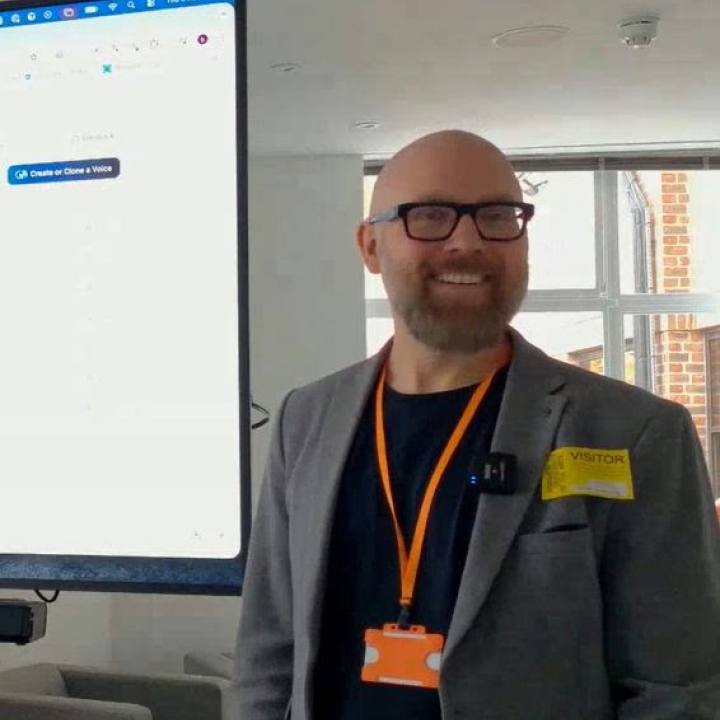
I had a great time chatting with students at Norwich University of the Arts.
It was a chance to share a bit about the creative industry, the realities of building digital products, and a project that has become personally important to me: a digital speaking aid for stroke survivors and people with aphasia.
The project uses AI carefully to help create more natural language options, and ElevenLabs to support voice cloning when there is explicit consent and suitable source audio. The aim is simple, even if the work behind it is not: help people reconnect with how they used to sound.
Why It Felt Like The Right Conversation
Creative students are often comfortable with ambiguity. They are used to exploring ideas, testing possibilities and asking whether something should exist, not only whether it can be made.
That mindset matters when talking about AI.
It is easy for conversations about AI to become either breathless or defensive. The useful space is usually somewhere quieter: what problem are we solving, who benefits, what could go wrong, and what responsibility does the maker carry?
Those questions came through clearly in the room.
Showing The Speaking Aid
Presenting the speaking aid was useful because it made the discussion practical.
This was not AI as an abstract trend. It was AI being used in a narrow, human context where the wrong design choices could make life harder for someone already dealing with communication barriers.
That changes the design brief.
The interface needs to be predictable. The language needs to be short and useful. The user has to remain in control. Voice cloning has to be treated with care, because hearing a familiar voice again is emotionally significant, not a gimmick.
Accessibility is not an extra layer on top of that work. It is the work.
The Q&A
The Q&A was open and thoughtful.
We talked about the exciting parts of AI, including faster ideation, more accessible tools and new forms of creative support. We also talked about the difficult parts: originality, labour, consent, authorship, bias and whether some uses are simply not worth the cost.
That balance matters.
Students entering the creative industries will not be able to ignore AI, but they also do not need to accept every use of it uncritically. The strongest creative work will still need taste, judgement, context and care.
Tools can accelerate a process. They cannot replace the responsibility behind it.
Leaving Encouraged
I left encouraged by the quality of the questions and the willingness to sit with the awkward parts of the topic.
That is exactly the kind of conversation the creative industry needs more of: practical, curious, honest and grounded in people.
Thanks to Norwich University of the Arts for having me. I loved being part of it, and I hope to come back again soon.
Need a steady technical partner for a web project?
Bring in senior help for planning, delivery, review or long-term support without adding more moving parts.