Article
Laravel's AI Turn Still Needs Clear Boundaries
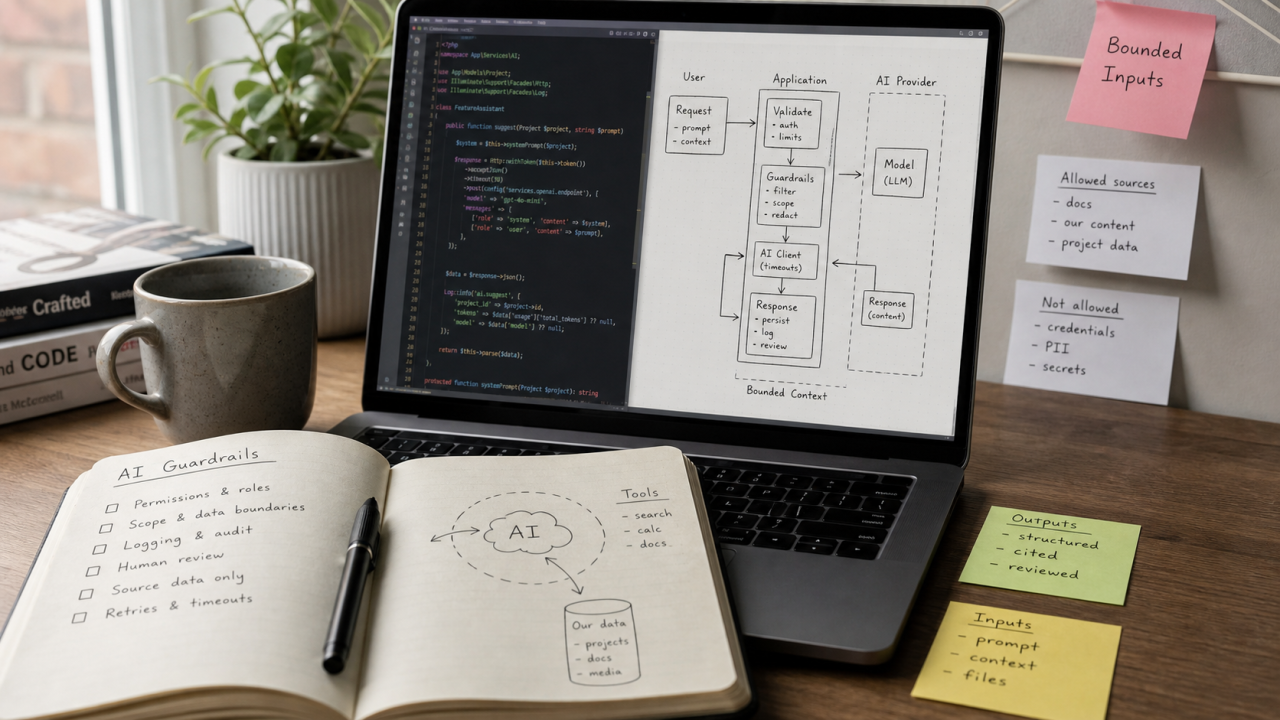
Laravel has made a clear decision.
With Laravel 13, AI is no longer something happening just outside the framework in scattered SDK wrappers, experimental side projects or vague product ambition decks. It now has first-party shape inside the ecosystem: an AI SDK, MCP support, semantic search primitives and Boost for giving coding agents deeper application context.
That is a meaningful shift.
It is also the point where teams need to stay disciplined.
Because the most useful thing about a framework embracing AI is not that it makes demos easier. It is that it gives you a better chance to keep the architecture honest.
The Interesting Part Is Not The Prompt
There is no shortage of AI examples that look impressive in isolation.
Generate some text. Summarise a record. Classify a message. Search by similarity. Wire an agent into a workflow. None of that is especially difficult now, and that is precisely why the framing matters.
Once the mechanics become easier, the risk moves elsewhere.
The real problem is rarely whether a model can return an answer. It is whether the answer belongs in that part of the system, whether the surrounding workflow has enough guardrails, and whether the people maintaining the application can still understand what is happening six months later.
That is where framework-level support can help, if it is used properly.
A First-Party Layer Can Improve Restraint
Laravel 13's release notes describe the new AI SDK in deliberately broad terms: text, tools, embeddings, images, audio and vector-store integrations through one Laravel-native interface. The MCP package and Boost extend that same direction by making AI tooling and application context feel less bolted on.
I think the important word there is not AI. It is interface.
When a framework gives teams a consistent way to express capabilities, it becomes easier to decide where those capabilities should live. You can put model calls behind services. You can separate editorial review from generation. You can make provider swaps less painful. You can keep logging, permissions, retries and fallbacks in places the application already understands.
That is much healthier than having fragments of AI logic hidden in controllers, template layers, third-party automations and hurried environment variables.
The abstraction does not solve the design problem on its own. But it can stop the technical shape becoming chaotic quite so quickly.
Context Is Part Of The Architecture
Laravel's AI documentation also leans into something else that matters: context.
Boost is presented as a way for coding agents to inspect routes, logs, database structure, Artisan commands and application state through MCP-aware tooling. That is useful. It acknowledges something many teams are now learning in practice: AI quality is often less constrained by raw model capability than by the quality, structure and permissions of the context you allow into the system.
That is true in product features as well as coding workflows.
If you build an internal assistant on top of tangled content, unreliable metadata and unclear boundaries, the assistant inherits those weaknesses. If you connect an agent to an application without clear tool limits, review points or separation of concerns, you have not created leverage. You have just moved uncertainty into a faster loop.
This is one reason I keep coming back to CMS and content architecture when AI comes up.
For content-managed systems, the exciting question is not whether a model can generate copy. It is whether the content model, editorial workflow and source material are strong enough to support useful assistance without quietly lowering the standard.
The Better AI Projects Will Look Slightly Boring
That may sound underwhelming, but I think it is where the better work is going to be.
The strongest Laravel AI projects are unlikely to be the ones with the loudest agent story. They will be the ones where the boundaries are clear:
- what the model is allowed to do,
- what source of truth it may use,
- what must be reviewed by a human,
- what gets stored,
- what gets logged,
- and what happens when the model is wrong, unavailable or too expensive to call casually.
Those decisions are not glamorous. They are architecture, product thinking and delivery discipline.
They are also what separate a credible feature from an expensive experiment.
Why This Matters For Client Work
For agencies, consultants and in-house teams, framework support can create a dangerous illusion as well as a useful one.
The useful illusion is that AI can start to feel like normal application work. In some respects, that is good. It means teams can bring familiar engineering habits to a new class of capability.
The dangerous illusion is that because the API looks tidy, the product decision must also be tidy.
It is not.
AI features still need careful calls on consent, provenance, accessibility, tone, failure states, editorial control and long-term operating cost. If the application deals with search, content, support, healthcare, hiring, assessments or anything reputationally sensitive, those questions become more important, not less.
A neat framework abstraction should lower implementation friction. It should not lower judgement.
What I Think Laravel Actually Gets Right
The best thing about Laravel moving further into AI is not that it is chasing a trend. Plenty of frameworks will do that.
It is that Laravel is trying to absorb AI work into patterns developers already recognise: services, queues, resources, commands, clear package boundaries and documented conventions. That gives teams a chance to build useful things without treating every feature like a one-off lab experiment.
That is worth paying attention to.
But the real standard should stay the same.
Use AI where it meaningfully reduces friction or unlocks something worthwhile. Keep the boundaries clear. Keep the source material strong. Keep a human standard over the final result. And if the architecture starts becoming vague, magical or difficult to explain, take that as a warning sign rather than a mark of sophistication.
The tools are getting easier.
That does not remove the need for judgement. It mostly changes where judgement needs to be applied.
Sources
Need senior support on a web project?
Bring in focused technical help for planning, build, review or long-term support.